
Flora Fauna Nusantara (FFN) supported student empowerment initiatives at Darul Izzah Islamic Boarding School through oyster mushroom cultivation training focused on entrepreneurship, practical skills, and sustainable economic opportunities.
As part of efforts to strengthen entrepreneurship skills based on local biological resources, Flora Fauna Nusantara (FFN) supported a community empowerment activity titled “Oyster Mushroom (Pleurotus sp.) Cultivation Training as a Student Empowerment Program at Darul Izzah Islamic Boarding School in Jember.” The program was conducted in 2021 at Darul Izzah Islamic Boarding School, Ambulu District, Jember Regency.
The activity aimed to provide students with practical knowledge and hands-on experience in oyster mushroom cultivation, while also encouraging the development of independent entrepreneurship within the boarding school environment.
The program began with surveys and coordination meetings involving boarding school supervisors and students to discuss implementation plans and community needs. Following this stage, the implementation team prepared cultivation tools and materials, including nursery bottles, husks, bran, and mushroom seeds such as F0 and F2 spawn.
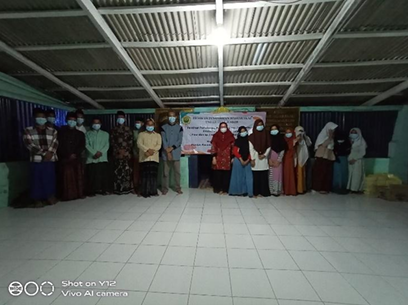
The training workshop was held on October 18, 2021, involving male and female students as well as boarding school supervisors. The training materials covered entrepreneurship concepts, oyster mushroom cultivation techniques, product processing, and marketing strategies.
The activity was not limited to classroom discussions, but also included direct cultivation practice and intensive mentoring throughout the cultivation process. Assistance was provided both through face-to-face communication and online platforms such as WhatsApp and phone calls to help participants address technical challenges during implementation.
One of the challenges encountered during the activity was contamination in several mushroom growing media (baglogs), which caused cultivation failure in some units. In response, the mentoring team provided technical guidance emphasizing the importance of sterile inoculation procedures and the use of special inoculation boxes to reduce contamination risks from unwanted microorganisms.
Interestingly, the students showed strong enthusiasm throughout the training activities. In addition to learning cultivation techniques, participants also gained an understanding of the economic potential of oyster mushroom products and their opportunities for development into small-scale business initiatives within the boarding school community.
This activity demonstrates how community empowerment programs based on practical education and local biological potential can create meaningful opportunities for younger generations while encouraging the growth of knowledge-based and skill-based economic independence.